


The QT Model – a framework for quality teaching

The desire to improve teachers and teaching is a common refrain in the media and by politicians, often in ways that don’t respect the complexity of classroom practice or that are simply disrespectful of teachers and the work that they do.
At the QT Academy, we’re on a mission to support teachers to deliver high-quality teaching that has a real impact on student achievement. Our Quality Teaching Model provides a clear framework for quality pedagogy based on decades of strong evidence.
Here, we explain the Quality Teaching Model, its features, research and implementation. Keep reading to learn how it drives professional development through a structured process known as Quality Teaching Rounds.
Understanding quality teaching?
What’s most important to ensuring learning is the quality of teaching delivered.
But what do we mean when we say ‘quality teaching’?
What does it really involve, how is it measured, and which strategies actually work?
As a profession, we have struggled to define quality teaching. This lack of definition often leads to assumptions about the quality of teachers as opposed to teaching.
It can lead to ideological battles about teaching strategies such as explicit instruction vs inquiry learning, teacher directed vs student centred learning when, depending on the context, the lesson and the needs of the students, all these teaching approaches can be valid and impactful.
As we would think about the practice of law, or the practice of medicine, the QT Model is about the practice of teaching – key principles that underpin what constitutes quality teaching.
What is the Quality Teaching Model?
-
New Release
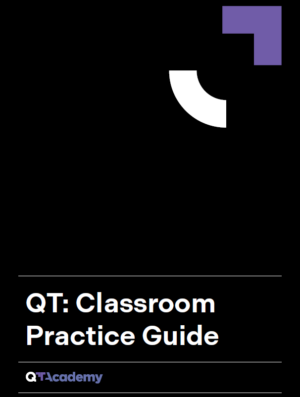
QT: Classroom Practice Guide (hard copy)
The QT: Classroom Practice Guide takes you through each of the 18 elements of the QT Model, providing detailed descriptors, a coding scale, and insightful notes and suggestions to help you grasp what it truly means to teach well.
Through ongoing rigorous research, we found that having a quality teaching framework is not enough to improve teaching practice.
The QT Model provides the shared conceptual language for defining and understanding quality. However, it’s only when the QT Model is applied through the powerful processes of Quality Teaching Rounds (QTR) that real improvement occurs.
QTR is a pedagogy-focused approach to teacher professional development that works for all teachers across every grade, subject and experience level. Initially adopted by 16 schools in 2009, it’s now used across Australia’s education system.
This collaborative process traditionally starts with at least two teachers per school attending a two-day QTR Foundational workshop.
Those two teachers then join two more teachers back at school to form a Professional Learning Community (PLC). Here, they observe a whole lesson of one member, before analysing and discussing the approach using the QT Model to refine their classroom practice together.
Completing a ‘set of Rounds’ means this process is repeated on separate days until all four teachers have undergone a lesson observation.
Those colleagues can then form new PLCs with other teachers to lead them through the process. As teacher participation increases, QTR ‘ripples’ across the school.
Proven to enhance student achievement
Research conducted by the University of Newcastle’s Teachers and Teaching Research Centre shows that by engaging in QTR, educators improve the quality of their teaching and experience greater collaboration, stronger self and collective efficacy, enhanced teacher wellbeing, and a stronger school culture that supports learning.
Together, these positive effects help to foster student academic achievement. Randomised controlled trials found that student achievement in mathematics was 25% greater when their teachers participated in QTR compared to a control group.
Since 2019, more than 7,500 teachers from more than 1,600 Australian schools have participated in a QTR workshop, potentially impacting as many as one million students’ lives.
Resources matter too
In the quest to improve teaching and learning, we must support teachers with professional learning that works.
Yet it would be remiss not to acknowledge the enormous contribution of out-of-school factors in determining student outcomes.
Studies, both in Australia and internationally, point to socio-economic inequalities having concentrated and considerable effects on student engagement and achievement. Inadequate resources and disadvantage in low socioeconomic schools play a significant role in students’ poorer educational outcomes.
Teachers, teaching and teacher education cannot alone make the improvements sought without considerable commitment to, and investment in, rectifying longstanding inequalities.
Discover teacher professional development with the QT Academy
Interested in refining your teaching practice? Join over 7,500 teachers who have participated in QTR since 2014.
Grounded in the QT Model, QT professional development strengthens classroom practice, assessment and curriculum planning to engage learners and improve student outcomes.
Get started with an online or face-to-face workshop.
