


Vulnerability and collegiality lead the way in Trinity’s Quality Teaching Rounds

Key Points
-
Trinity Grammar School joined the Strengthening Induction through QTR in 2025, with the aim to provide better support for early career teachers.
-
Teachers work in small “Hub” groups to observe and analyse lessons, building a shared language for effective teaching.
-
“[The initiative] inspires collaboration, collegiality, critical thinking, thoughtful teaching practice, and holistic professional development,” said Ms Carolena Kostas
-
Participants reported stronger reflection, collaboration, and professional confidence, benefiting both early career and experienced teachers.
Originally published by Trinity Grammar School
In 2025, a new professional growth initiative launched at Trinity: Quality Teaching Rounds (QTR) for Early Career Teachers.
The initiative is headed up by Ms Natalie Bluhdorn (Dean of Professional Pathways) and operates in collaboration with the University of Newcastle (UON) and the Quality Teaching Academy. The overarching research project conducted by UON is called ‘Strengthening Teacher Induction Through QTR’, aligning perfectly with Trinity’s commitment to supporting and growing early career teachers.
The program involves a group of teachers – at Trinity, they are called ‘The Hub’ – observing, analysing, and discussing each other’s lessons, guided by a comprehensive pedagogical model, the Quality Teaching Model.
“There’s a lot of trust here, and the girls are beautiful learners as well, so they make it really hard to [want to] go anywhere else. They’re willing to let you try and fail and try and succeed at various teaching and learning strategies, and they really embrace the risks that you take.”
When first considering this opportunity, Ms Bluhdorn says that she saw how valuable it would be for early career teachers to dig deep into observation and feedback to understand teaching practice – not just what works, but why it works.
“There’s good teaching going on, great pedagogy, good collegiality, but we don’t always have a common shared language to talk about it,” Ms Bluhdorn says. “We need to be able to see the value, identify the elements of what’s working and articulate that with one another.”
The QTR process has four steps that all take place on one day:
- The Hub meets together in Period 1 to discuss a journal article or other current literature, guided by an agreed upon discussion approach
- Period 2, one member of the group is the ‘Host’ for this round. They teach a normal lesson while the other three members of the Hub take notes relating to 18 elements outlined by the Quality Teaching Academy. These elements fall under three domains: intellectual quality, quality learning environment, and significance. A careful approach is taken to ensure the observation and note taking relates strictly to the relevant elements, not creating any personal commentary on the teacher who is ‘hosting’ the round.
- In Period 3, each participant spends time alone, individually coding each of those elements on a scale of 1–5 based on their observations. In this step, it’s important that each participant has justification, backed up by their observation notes, for their coding.
- In Period 4, the Hub re-convenes for discussion as they each share how they coded the individual elements. The discussion is guided by a considered protocol so that feedback is never personal. Often this is a rigorous, robust conversation as the Hub considers each element, their individual observations, and the resources from the Quality Teacher Academy. Together, they come to an agreement on the coding.
The ‘host’ of each round then gets a chance to reflect on their experience of being observed and given feedback.
This process repeats, about a week apart each time, until each member of the Hub has had a chance to ‘host’ and be observed. Additionally, the participants take part in two days of training with the University of Newcastle and complete surveys throughout the process to aid in the data collection which will then feed into developing the confidence and resilience of early career teachers.
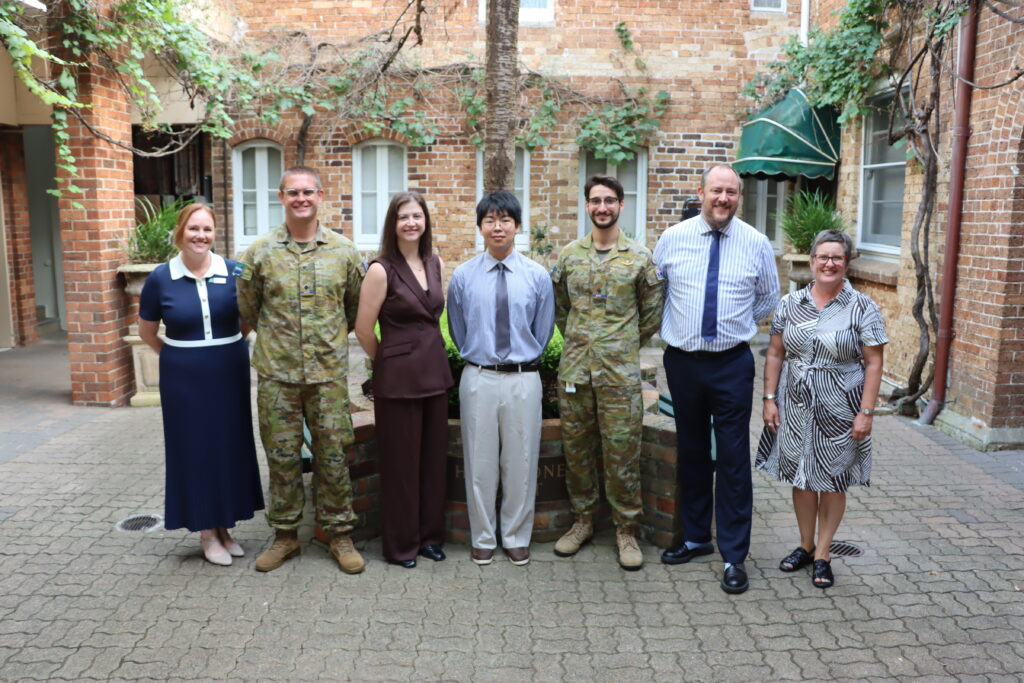
In their final reflections, each member of the 2025 Hub shared what they gained from the experience.
“The faculty I’m in has a diverse range of experience and I think by having this as a common routine, it gives us an opportunity to share our insights – which would be diverse – and grow as professionals,” said Mr Kevin Yoon (Mathematics).
Mr Jonathan Saunders (Economics) echoed the sentiment that the QTR process would be beneficial for all teachers, not just those in the early stages of their career and that it could be of further benefit if the program went even longer.
“[The initiative] inspires collaboration, collegiality, critical thinking, thoughtful teaching practice, and a holistic development of the teachers who take part,” said Ms Carolena Kostas (English).
All in all, Ms Bluhdorn says it’s a “very active, very rich process” and one that she has benefitted from greatly, despite being the assigned ‘experienced teacher’ within the Hub.
“Over time, teaching becomes intuitive,” she reflects. “I know what works in my classroom and I do it, but I don’t always get a chance to reflect so deeply on why I do it.”

The Quality Teaching Academy itself describes the model as a process that “honours the complexity of teaching and respects what teachers already know and do”.
For those participating in the initiative, it’s incredibly valuable – not only for their own practice but for equipping them with the language to share their knowledge beyond the experience.
“The staff have to make themselves vulnerable and it’s a great act of collegiality and being professional,” says Ms Bluhdorn.
Quality Teaching Rounds are continuing this year with the continued partnership of the University of Newcastle. Participants began the process in early February and will follow the same methods as last year’s cohort.
